


Lightness Finds Its Way. Ludovico Focato, Project Manager of Tecnoproteo, Tells the Story

Industrial research on sustainable transport has new objectives. Among these: replacing metal vehicle parts with components made from lighter materials, recycling secondary raw materials at rates exceeding 50%, and adapting existing technologies.
This is the goal of Tecnoproteo Upcycling Future, a research project involving EURODIES Italia s.r.l. (lead partner), F.T. FAMAT S.R.L. , 2 Gamma, CRF Stellantis, Environment Park and Politecnico di Torino. All working in partnership for 30 months.
The project is described by Ludovico Focato, industrial engineer at Eurodies since 2023 and project manager for Tecnoproteo.
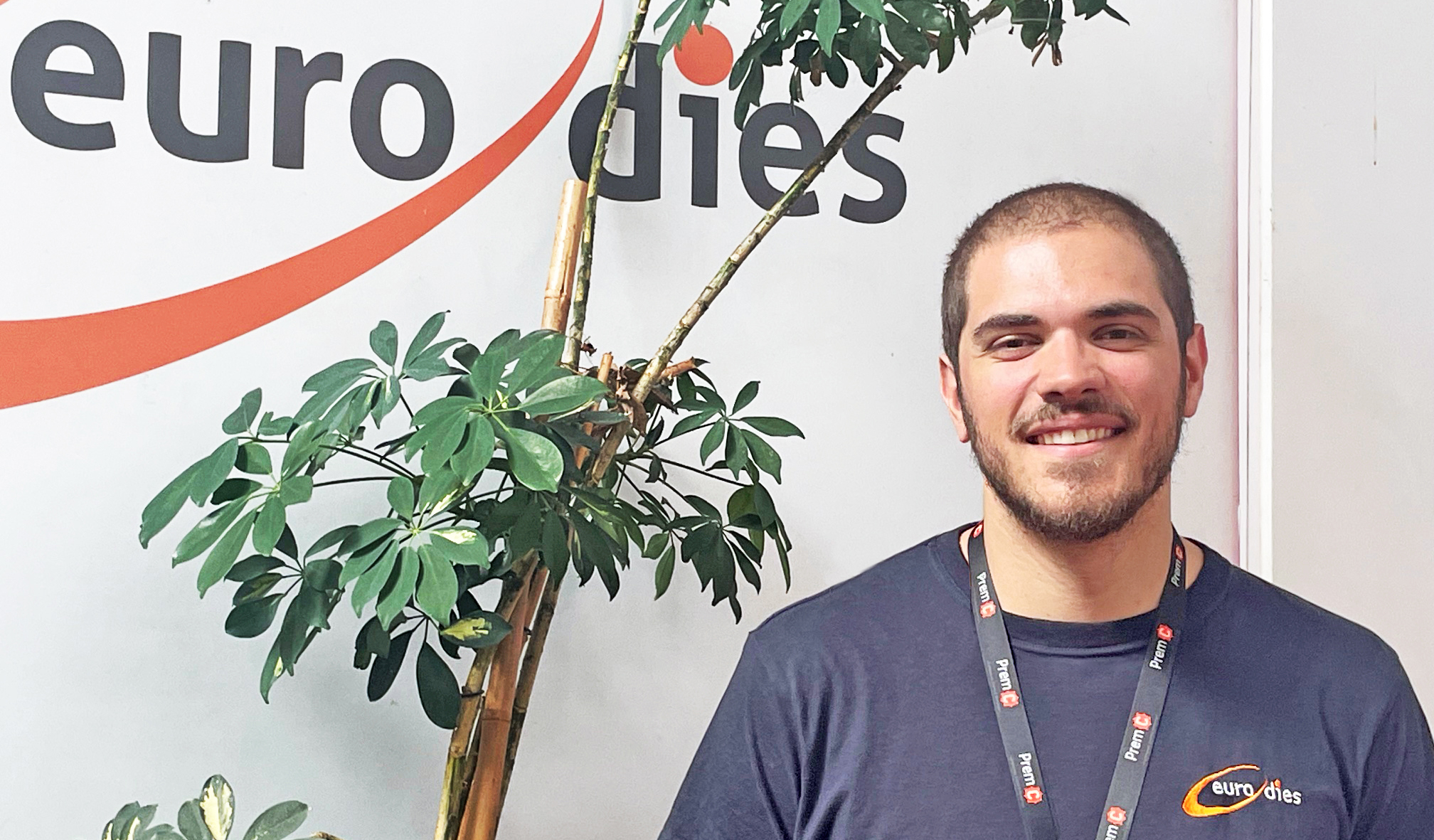
Ludovico Focato, industrial engineer and project manager for Tecnoproteo
Current Context: Market and Supply Chain
Ludovico, what are the main trends and challenges in the transport sector, particularly in the automotive industry, with regard to materials and sustainability?
The evolution in the transport sector is driving a new approach to vehicle component manufacturing. The main challenges include the need to orient component design according to environmental sustainability criteria. This aims to reduce CO2 emissions during production and minimise end-of-life impact through disassembly and material recycling logic. Added to this is the pressing need for lightweighting, to ensure greater energy efficiency, especially in electric vehicles. All this is reinforced by European legislative pressure towards the increasing use of recycled materials.
How does the current sheet metal stamping supply chain position itself in relation to these new requirements?
The Sheet metal stamping remains one of the most important sectors today. Notably, the thermocompression of innovative composite sheets can be traced back to this supply chain — both in terms of equipment (vertical presses) and processable geometries and operational sequences.
A successful outcome for Tecnoproteo would allow existing plant investments to be safeguarded, complementing traditional sheet metal production with the stamping of composite sheets, in order to largely replace the use of metal alloys. The contribution to the environmental and economic sustainability of the vehicle would be highly significant. This is the macro-objective of the research project.
How can the different supply chains of Tecnoproteo’s partners collaborate to create a new and innovative one?
The current sheet metal stamping supply chain, well-established and highly important, is represented by the expertise of Eurodies, the project’s lead partner. Building on its roots in the production of prototypes components, Eurodies is specialising in complex structural components. This expertise is proving crucial in studying the manufacturability of reinforced thermoplastics to meet recycled material regulations. This process could also open doors to new market sectors, such as construction and aerospace.
Equally relevant is the expertise of the other partners: 2Gamma, in the production of thermoplastic technical films and composite materials, and F.T. Famat, with its expertise in bespoke special automation and its plant engineering and ICT expertise, which are crucial for the new supply chain. 2Gamma plans to grow in the construction and mobility sectors, offering low environmental impact products with a high percentage of recycled material and localised reinforcements. F.T. Famat, by investing in R&D on new technologies, will enhance its expertise in surface treatments and automation/control solutions with sensors, applicable across various industrial sectors.
The collaboration between these three production supply chains is supported by three research centres: Politecnico di Torino, Environment Park and Centro Ricerche Fiat (CRF), responsible for the technological and economic validation of Tecnoproteo. An essential contribution that amplifies the research development potential.
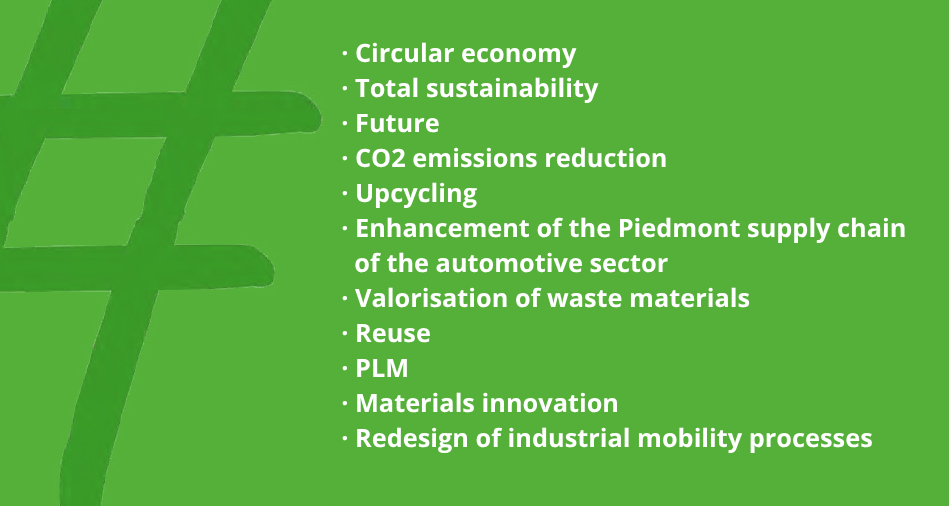
Key words of the Tecnoproteo project
The “Tecnoproteo Solution”
What does Tecnoproteo’s innovative solution consist of?
The Tecnoproteo project focuses on developing thermoplastic composites in sheet form, both consolidated and unconsolidated, for use in thermocompression processes. The main innovation is the use of thermoplastic material, rather than thermoset, linked to the search for recycled raw materials, for both fibres and matrix.
What are the advantages of this process compared to thermoplastic injection moulding or the stamping of metal sheets such as aluminium, in terms of energy and recycled materials?
Compared to thermoplastic injection processes, thermocompression yields a clear energy saving. It requires only a softening of the material, rather than full melting. In addition, sheets offer greater lightweighting potential, as the reinforcing fibres are not necessarily broken up as they are in injection moulding. Compared to metal sheet stamping, such as aluminium, energy is also saved due to the lower pressures required for production, and there are greater opportunities to use recycled material. The goal is to produce thermoplastic composite sheets with recycled raw material content exceeding 50%, whereas aluminium sheets currently do not allow the use of secondary raw material above 30%.
Open Challenges
Despite the advantages, what are the main critical issues and challenges that the Tecnoproteo project must address?
The challenges are of various natures. One is the control of heating and cooling cycles, temperature uniformity during sheet processing and the selection of appropriate geometries. Finally, adapting existing machinery and creating more specific production tooling are necessary: two interventions that may represent a significant investment for the industrial partners. We are working on it.
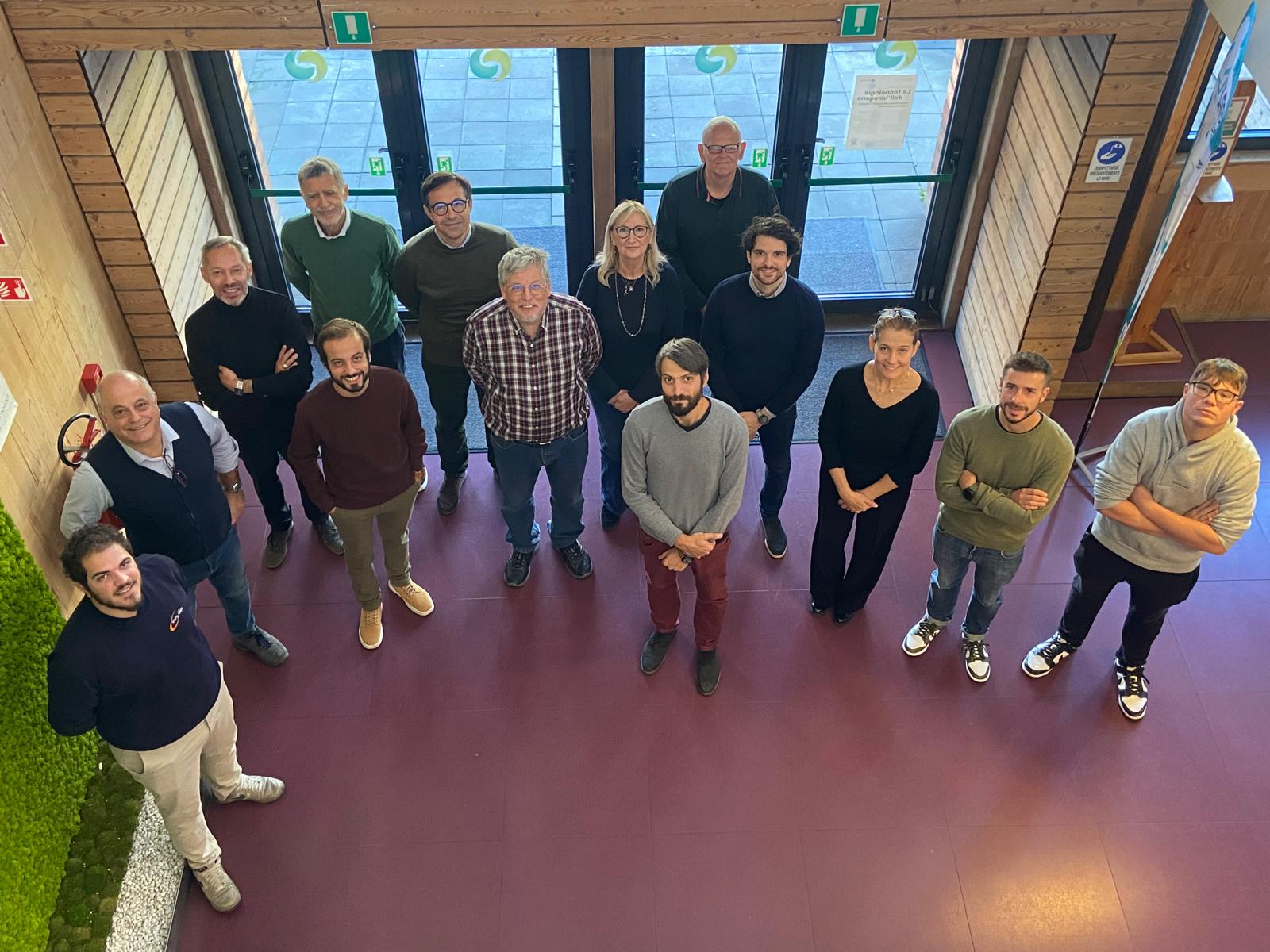
The Tecnoproteo project team
Expected Benefits
What are the key benefits expected from the technological implementation developed by Tecnoproteo?
Once the challenges are overcome, the benefits are many — and undeniable. A significant reduction in component weight for equivalent function, for instance, improving fuel efficiency in internal combustion vehicles and increasing the range of electric ones. There is also great design flexibility, with the possibility of producing sheets with different fibre types and thicknesses, thermoformable into various complex shapes. The process, if automated, should prove more economical, versatile and efficient than injection moulding. Finally, thermoplastic composites are recyclable: they contribute to sustainability goals and offer high impact resistance, improving vehicle safety.
What specific outcomes are expected for the project partners and for the Piedmont region?
For Eurodies, developing new know-how in the stamping of reinforced thermoplastic components would open doors to new areas of the vehicle market and potentially to other sectors, such as aerospace and construction. 2Gamma would expand its market with thermoplastic composite laminates of low environmental impact. F.T. Famat would enhance its expertise in surface treatments and automation solutions with sensors, applicable across various sectors.
CRF, as representative of Stellantis, would validate the benefits of the solutions, guiding R&D to integrate new products on vehicles, with a focus also on end-of-life reuse and recycling. Environment Park would enrich its knowledge in LCA, ecodesign and support for low-impact supply chains.
Finally, Politecnico di Torino would strengthen its role in supporting industrial innovation for the growth of the regional production system. Benefits for subsequent industrialisation phases would also be significant, both in terms of CO2 reduction and conversion of plant infrastructure, reorganisation and requalification
To Wrap Things Up
How engaging is this project for an engineer with your background and experience?
This project is truly captivating. For a management engineer drawn to innovation, taking part in the study of an infrastructural transformation is a unique opportunity. At Eurodies, together with our partners, we are laying the foundations for future high-tech investments starting from materials – something very concrete in favour of the sustainability of vehicles and processes. The green transition brings with it both significant benefits and major challenges. Tackling them alongside experts from different fields is an extraordinary exchange of knowledge.
Find out more about the project on the Tecnoproteo website